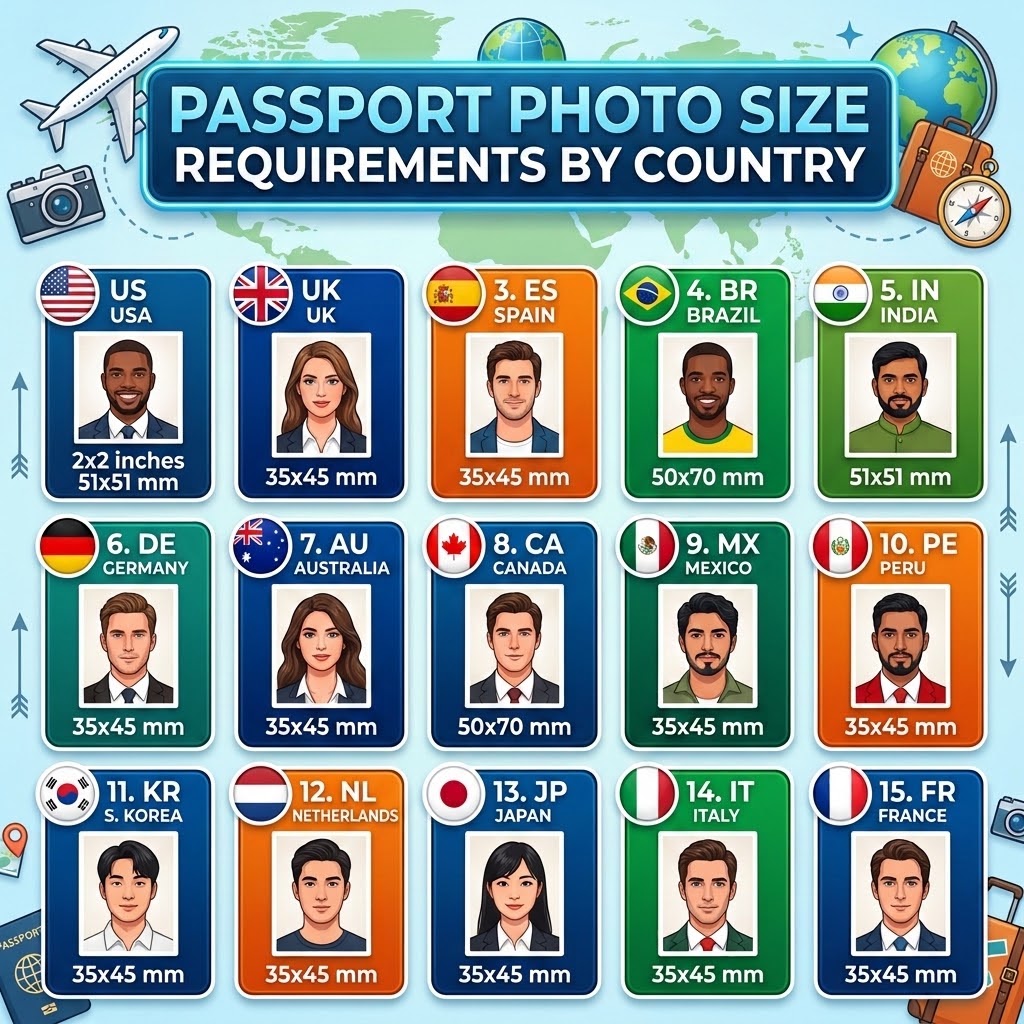
Passport Photo Size Requirements by Country (2026)
Last verified: 22 July 2026. Every spec below was checked against the official government source on that date — each row links to it. Photo rules change; if you spot an outdated value, email support@resizeimage.io and we’ll re-verify.
Getting a passport photo rejected is one of the most common — and most avoidable — delays in a passport or visa application. The reason is almost never the photo itself. It’s that the size, background, and head position differ from country to country, and most “guides” online just copy each other’s outdated numbers.
This page is different: every figure below comes from the issuing government’s own page, with the date we verified it. Bookmark it, or jump straight to your country.
The short version
Most countries use one of two sizes:
- 35 × 45 mm — the international standard (UK, most of Europe, India, Australia, Japan, Korea, and more)
- 2 × 2 inches (51 × 51 mm) — the United States and countries that follow the US standard
Backgrounds are almost always plain white or light grey, and the single most common rejection reason after background is head height — how much of the frame your face fills. A few countries break the mould entirely (Spain, Brazil, Canada), which we cover below.
Passport photo requirements: full comparison table
| Country | Print size | Pixels @ 300 DPI | Background | Head height | Digital / file rules | Official source | Verified |
|---|---|---|---|---|---|---|---|
| United States
|
51 × 51 mm (2×2 in) | 600 × 600 | Plain white / off-white | 25–35 mm (1–1⅜ in) | 54 KB–10 MB; JPG, PNG, HEIC, HEIF | travel.state.gov | 22/07/26 |
United Kingdom |
35 × 45 mm | 600 × 750 | Plain, light-coloured | Clear, in focus | Digital 50 KB–10 MB; no red-eye | gov.uk | 22/07/26 |
| India
|
35 × 45 mm | 630 × 810 | Plain white | Face 80–85% of photo | No official digital spec published | passportindia.gov.in | 22/07/26 |
| Canada
|
50 × 70 mm (2 × 2¾ in) | 1200×1800 to 3000×4500 | Plain white | 31–36 mm | JPG, 3:2 portrait, 200 KB–5 MB; chin-crown 40–45% of height | canada.ca | 22/07/26 |
| Australia
|
35–40 × 45–50 mm | Glossy print <200 gsm | Plain white / light grey | 32–36 mm | No official digital spec published | passports.gov.au | 22/07/26 |
| Germany
|
35 × 45 mm | — | Plain white | 32–36 mm (70–80% of height; 50–80% for minors) | Since 1 May 2025: digital biometric photo only, taken at an authorised Bürgeramt | bmi.bund.de | 22/07/26 |
| France
|
35 × 45 mm | — | Light blue / light grey | Uncovered, facing forward | ePhoto via ANTS (agréé photographer/booth) | ants.gouv.fr | 22/07/26 |
| Italy
|
35 × 45 mm | — | Plain, light-coloured | 80% of photo height | No official digital spec published | poliziadistato.it | 22/07/26 |
| Spain
|
35 × 45 mm (Schengen visa) | — | Single-colour, natural light grey | 70–80% of frame (32–36 mm; children <9: 22–36 mm) | No official digital spec published | Policía Nacional / DNI
(Link) |
22/07/26 |
| Netherlands
|
35 × 45 mm | — (≥400 DPI) | Light grey, light blue or white; colour only | Face length 26–30 mm (11+), 19–30 mm (<11); width 16–20 mm | No official digital spec published | netherlandsworldwide.nl | 22/07/26 |
| Japan
|
35 × 45 mm | — | Plain white or light blue solid; no gradient | 32–36 mm; top gap 4±2, face 34±2, bottom 7±2, centre 17±2 | Colour only, borderless (ICAO 9303 / MOFA) | mofa.go.jp | 22/07/26 |
| Mexico
|
35 × 45 mm (visa) | — | White | ~34.5 mm | Passport photo taken on-site at the consular office | gob.mx | 22/07/26 |
| Brazil
|
50 × 70 mm (5×7 cm) | — | Plain white | — | Printed photo at the appointment (Polícia Federal) | gov.br/pf | 22/07/26 |
| South Korea
|
35 × 45 mm | — | Pure white (cream/grey rejected) | 32–36 mm | No sunglasses or hats; colour, within 6 months | passport.go.kr | 22/07/26 |
| Peru
|
35 × 45 mm | — | Light grey or plain white | 70–80% of height (32–36 mm) | ISO/IEC JTC 1/SC 37 biometric standard | gob.pe | 22/07/26 |







How to read the table?
- Print size vs pixels. The millimeter size is for a printed photo; the pixel size is what an online application needs, calculated at 300 DPI (the print standard). If a portal rejects your photo for resolution, change its DPI to 300 here.
- Head height is measured chin to crown. Getting this wrong — face too big or too small in the frame — is the top rejection reason after background problems.
- Background. “Plain white” means pure, even, and shadow-free. Wall shadows behind your head count as a fail. Remove and replace your background here.
- Digital / file rules. Online portals add their own limits on top of the print size — add a pixel range and meet a KB file-size cap. Meeting the print size is not enough; you have to hit the file rules too.
Make a compliant photo (free, in your browser)
- 2×2 inch resizer — US passport & visa
- 35×45 mm resizer — UK, EU, India, Japan, Korea, most countries
- 50×70 mm resizer — Canada & Brazil
- 600×600 resizer — US DV lottery
- White-background remover
- Compress to an exact KB — for portals with file-size caps
- Change DPI to 300
Every tool runs entirely in your browser — your photo is never uploaded to a server.
Why passport photo sizes are different around the world?
If almost everyone uses 35 × 45 mm, why the exceptions? Three reasons worth knowing before you apply:
1. The US chose a square. The United States standardised on 2 × 2 inches (51 × 51 mm) decades ago, and countries in its sphere of influence often followed. It’s the main reason “passport photo size” has two right answers.
2. A few countries kept their own national standard. Spain is the classic example — its national DNI and passport historically use a smaller portrait crop, even though its Schengen visa photos follow the EU’s 35 × 45 mm. Canada is another outlier at 50 × 70 mm, and Brazil uses the same 5 × 7 cm size — both noticeably larger than the global norm.
3. “Digital-first” is changing the rules right now. Germany moved to digital biometric photos only (taken at an authorised office) from May 2025, and more countries are following. The trend is away from the strip of printed photos and toward a verified digital capture — which is exactly why the “digital / file rules” column is becoming the important one.
The rules that get photos rejected (beyond size)
Size is easy. These catch people out:
- Glasses. Increasingly banned outright — several countries reject any glasses regardless of frame or anti-glare lens.
- Background colour precision. South Korea rejects cream and grey; it wants pure white. The Netherlands and France prefer light grey or blue. “White-ish” is not a safe default.
- Head-height tolerance. Countries like Japan specify this to the millimetre (face 34 ± 2 mm). A photo that’s fine in one country fails in another purely on framing.
- Recency. Almost universally “within the last 6 months,” and officials do check against your appearance.
- Filters and beauty edits. Modern rejection systems flag skin-smoothing and eye-enlarging. Your photo must look like you.
Frequently asked questions
What is the most common passport photo size? 35 × 45 mm — used by the UK, most of Europe, India, Australia, Japan and Korea. The United States and a few others use 2 × 2 inches (51 × 51 mm).
What DPI should a passport photo be? 300 DPI, the print standard. That’s why a 2 × 2 inch US photo is 600 × 600 pixels and a 35 × 45 mm photo is about 413 × 531 pixels at 300 DPI.
Why does the online portal reject my photo when the size is right? Portals add a separate file-size limit (in KB) and sometimes a pixel range, on top of the print size. Check the “digital / file rules” column and compress your photo to the required KB if needed.
Can I take a passport photo at home? In most countries, yes — if you meet the size, background and head-height rules. Some (Germany since 2025, France, Mexico’s consular process) now require the photo to be captured at an authorised location. Check your country’s row.
What size is a passport photo in pixels? It depends on the country and the DPI. At the 300 DPI print standard: US = 600 × 600; a 35 × 45 mm photo ≈ 413 × 531. Online portals may specify their own pixel range — always check the official source.
This table is maintained and re-verified quarterly. Last full verification: 22 July 2026.
Changelog
| Date | Change |
|---|---|
| 22 Jul 2026 | Initial publication — 15 countries verified against official sources |